 Skip to content
Modern slavery reporting is increasingly shifting from disclosure to enforcement, a shift occurring across a growing number of jurisdictions. On 30 June 2026, the UK introduced amendments mandating disclosures on risk assessment and due diligence, backed by significant fines. Weeks later, Australia’s Attorney-General announced plans for a new criminal offence for companies with annual consolidated revenue over A$100 million that fail to prevent modern slavery in their supply chains, with a defence available where a company can demonstrate it took reasonable steps. The proposed criminal offence is expected to sit under the Criminal Code, while proposed civil penalties would address non-compliance with existing reporting obligations under the Modern Slavery Act 2018 (Cth).
Two major jurisdictions moving from “publish a statement” to “prove you acted,” within weeks of each other, is a strong indicator of regulatory direction. The shift reflects increasing alignment with the approach the EU is already taking through CSDDD and the Forced Labour Regulation, and enforcement trends building in the US. For compliance teams operating across APAC, EMEA, and AMER, the message is the same wherever you sit: reporting alone may no longer satisfy the regulator.
This session will explore:
- The UK and Australian reforms and how “reasonable steps” defences are being defined
- Why regulators across multiple jurisdictions are converging on enforcement and due diligence rather than disclosure alone
- What this convergence means for organisations managing third-party risk across APAC, EMEA, and AMER supply chains
- How to move from a defensible statement to a defensible due diligence program, ahead of regulatory pressure
- Practical steps to prepare compliance and third-party risk programs for this shift
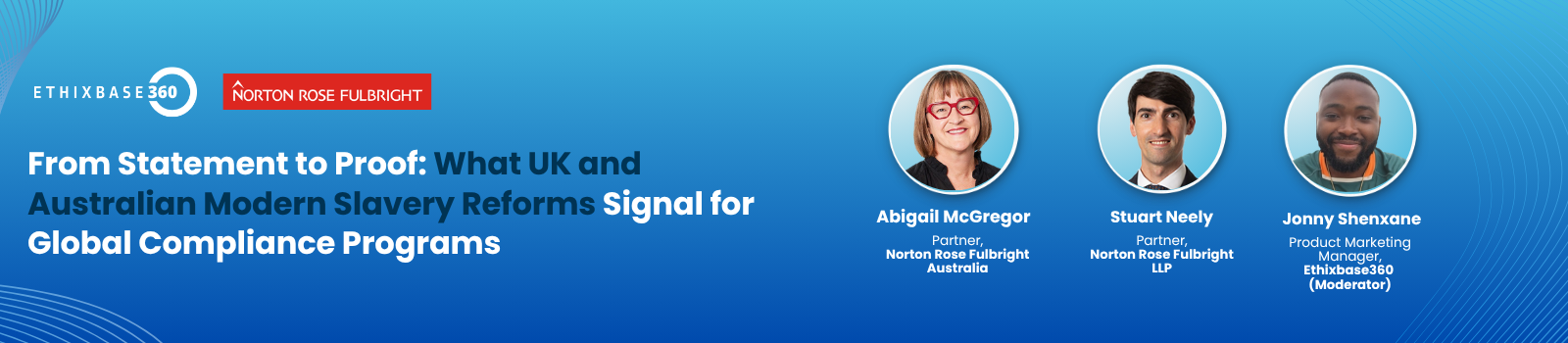
Speakers:
- Abigail McGregor, Partner, Norton Rose Fulbright Australia
- Stuart Neely, Partner, Norton Rose Fulbright LLP
- Jonny Shenxane, Product Marketing Manager, Ethixbase360 (Moderator)