 Skip to content
Human rights and modern slavery risks are receiving increasing regulatory and enforcement attention across global supply chains. Governments are moving beyond transparency-led approaches toward clearer expectations that companies proactively identify, assess, and address risks within their operations and across third-party networks.
In Europe, the Corporate Sustainability Due Diligence Directive (CSDDD) introduces more structured requirements for human rights and environmental due diligence across value chains. In the United Kingdom, organizations remain subject to reporting obligations under the Modern Slavery Act 2015, alongside ongoing policy discussions aimed at strengthening enforcement and introducing more robust due diligence expectations.
Across the Asia-Pacific region, regulatory expectations are also evolving. Australia’s Modern Slavery Act 2018 requires large organizations to identify and report on modern slavery risks within their operations and supply chains, while other jurisdictions across APAC—including Singapore and key regional trade hubs—are increasing focus on supply chain transparency, responsible sourcing, and governance frameworks. Emerging legislative and policy developments across the region signal a gradual shift toward more formalized due diligence expectations.
At the same time, enforcement globally is increasingly being driven through trade and import controls. Measures such as the U.S. Uyghur Forced Labor Prevention Act (UFLPA), alongside similar approaches in other markets, are placing pressure on companies to demonstrate that goods are free from forced labor. These restrictions have significant implications for APAC-based companies, particularly those exporting into the U.S., EU, and UK, and are accelerating the need for deeper supply chain mapping, traceability, and verification.
Against this evolving and interconnected landscape, many APAC-based organizations—whether operating locally or supplying into global markets—are facing growing expectations to strengthen third-party due diligence, risk monitoring, and documentation practices.
This session will explore:
- Key global and regional regulatory developments shaping human rights and modern slavery due diligence
- The implications of the EU CSDDD, UK Modern Slavery Act, Australia’s Modern Slavery framework, and emerging APAC regulations
- The growing role of trade and import controls in driving enforcement and supply chain accountability
- How human rights risks intersect with third-party risk management and supply chain oversight
- Practical approaches for identifying, assessing, and managing modern slavery risks across complex global supplier networks
Speakers:
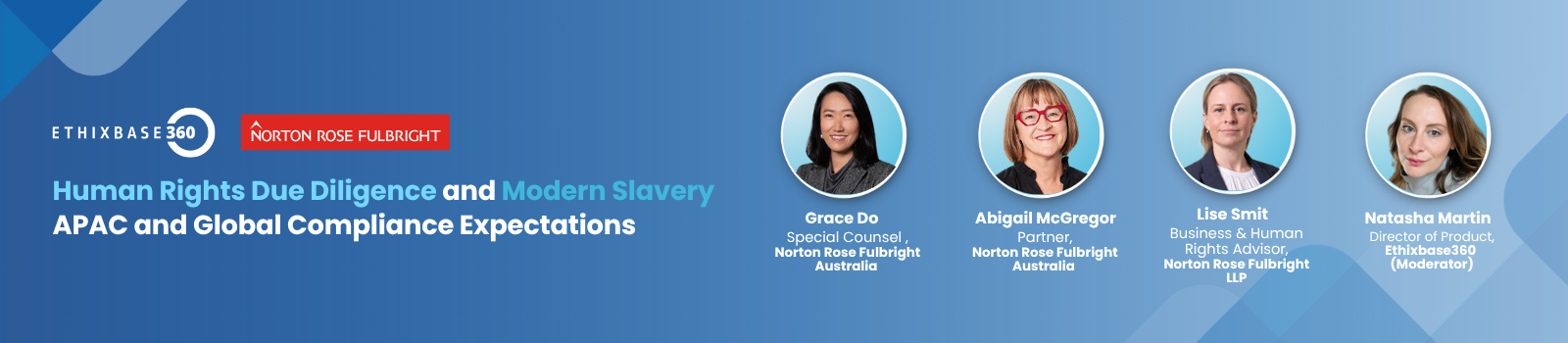
- Grace Do, Special Counsel, Norton Rose Fulbright Australia
- Abigail McGregor, Partner, Norton Rose Fulbright Australia
- Lise Smit, Business & Human Rights Advisor, Norton Rose Fulbright LLP
- Natasha Martin – Moderator, Director of Product, Ethixbase360
The session is designed for legal, compliance, risk, sustainability and procurement professionals operating across APAC and EMEA. For a broader global perspective, including U.S. and European enforcement trends, you can also join our companion session focused on the U.S. and EMEA.