 Skip to content
Modern slavery regulation is entering a new phase.
For years, many modern slavery laws have focused primarily on transparency: requiring companies to explain their policies, identify risks and describe the steps they are taking to address them. Developments across the UK, Australia and New Zealand increasingly point toward a different expectation: companies may need to demonstrate not simply that they have policies and processes, but that those processes are operating effectively in practice.
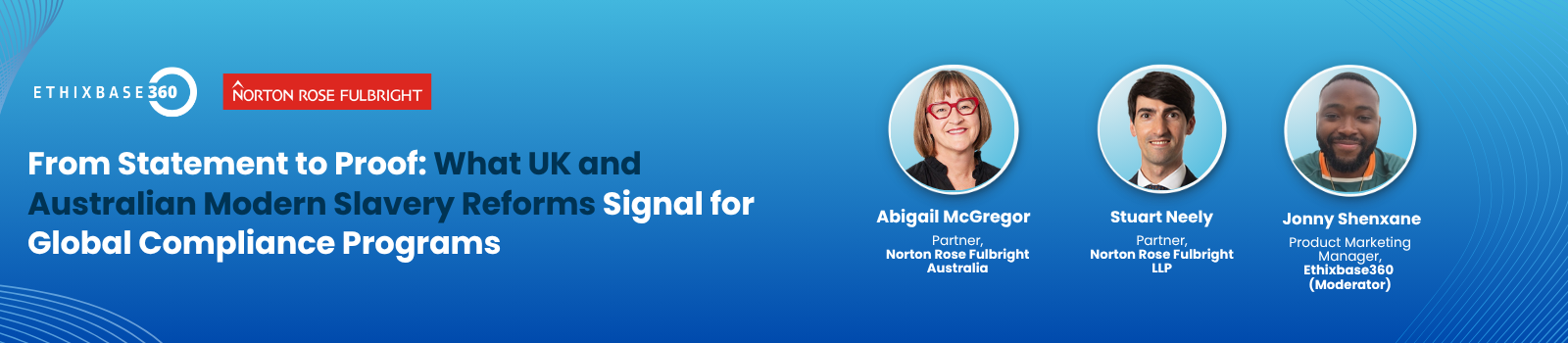
That shift was the focus of a recent Ethixbase360 webinar moderated by Product Marketing Manager Jonny Shenxane, with Norton Rose Fulbright partners Stuart Neely and Abigail McGregor, who co-lead the firm’s global business and human rights practice.
While many of the reforms discussed remain proposals, the broader shift is increasingly clear: modern slavery compliance is moving away from reporting and towards effectiveness.
The UK: stronger reporting requirements backed by significant penalties
The UK’s Modern Slavery Act was an early mover in corporate modern slavery reporting, but its effectiveness has long been questioned.
Its six reporting topics — including policies, due diligence, risk assessment, training and measures of effectiveness — are currently discretionary. Enforcement is also limited. As Neely explained, the Act has never been enforced through the courts in the manner contemplated by the legislation. Proposed amendments through the Immigration and Asylum Bill would materially change that approach.
Companies would be required to address the existing six reporting topics or explain why they have not taken those steps — effectively creating a “comply or explain” regime. Non-compliance could potentially result in fines of up to 1% of global turnover. The reforms would also extend reporting requirements to public authorities and introduce additional accountability around the accuracy of modern slavery statements.
But these changes may only be an interim step.
The UK government’s Responsible Business Conduct Review concluded in June 2026, against a backdrop of calls for mandatory human rights due diligence and forced labour import restrictions. Neely highlighted recent comments from the UK’s trade minister as one indication that further developments could follow:
“I am an impatient minister. I want us to get things done and to get them done quickly.”
No mandatory due diligence or forced labour import ban legislation has yet been tabled pursuant to these recent developments. For companies operating in the UK, however, the practical implication is to prepare for a compliance environment in which describing processes may increasingly need to be accompanied by evidence that those processes actually work.
Practical takeaway: Review existing modern slavery statements against the six reporting areas now. For every commitment made publicly, identify the underlying policy, control, training, due diligence activity or effectiveness measure that supports it. Where that evidence does not exist, the gap may be more important than the wording of the next statement.
Australia: preparing for a potential “failure to prevent” offence
Australia’s proposed reform takes a different approach. Rather than implementing the penalty and due diligence plan recommendations arising from the review of Australia’s Modern Slavery Act, the government has proposed a “failure to prevent modern slavery” criminal offence. The proposal surprised many practitioners.
“That was not one of the matters that was included in John McMillan AO’s review and recommendations,” McGregor said. “So it came from nowhere for most people.”
As currently proposed, the offence would apply to corporations with consolidated revenue above AU$100 million, aligning with the threshold under Australia’s existing reporting regime. A corporation would have a defence if it could establish, on the balance of probabilities, that it had taken reasonable steps to prevent modern slavery. Precisely what constitutes “reasonable steps,” however, remains to be determined.
McGregor argued that the fundamentals should ultimately be clear from the legislation itself rather than left entirely to subsequent guidance.
For compliance teams, one point is particularly important: having a policy is unlikely to satisfy that standard on its own.
“Simply having a policy will not be enough.”
McGregor suggested that companies looking to prepare now should look to the UN Guiding Principles on Business and Human Rights as an important framework for what reasonable due diligence could involve.
The proposed offence also raises significant questions that remain unresolved, including the required connection between the corporation and the underlying modern slavery conduct and whether the full due diligence programme, or measures relating to the specific modern slavery risk that materialised, would be relevant when assessing reasonable steps. Consultation is ongoing, with a variety of views in relation to the proposed offence.
Practical takeaway: Don’t wait for a final definition of “reasonable steps” before assessing your programme, commence a salient risk assessment now. Test whether commitments are actually embedded in procurement and supplier management, whether salient risks are prioritized, whether identified issues generate action and whether those actions are documented.
New Zealand: similar foundations, but potentially greater disclosure
New Zealand is also progressing modern slavery legislation, although passage may now slip into 2027. The proposed regime has been designed in part to align with Australia’s, reflecting the close relationship between the two economies and a desire to limit unnecessary regulatory duplication.
But the New Zealand proposal goes further in several areas.
Among other requirements, it would require reporting on identified modern slavery incidents, complaints or investigations and remediation, known or anticipated risks and training. It would also introduce penalties for failure to report and false or misleading statements, with potential personal liability for directors or officers knowingly involved in misreporting.
That creates an interesting challenge for companies operating across both Australia and New Zealand: disclosures made under one regime could have implications under another, particularly as Australia’s proposed failure to prevent offence develops.
Practical takeaway: Multinationals should avoid building completely separate modern slavery programmes jurisdiction by jurisdiction. Instead, establish a common global evidence base that can support different reporting requirements, while identifying where local laws require additional disclosures or controls.
Forced labour import bans change the compliance equation
The developments extend well beyond the UK, Australia and New Zealand. The panel noted that 44 countries now have, or have committed to introducing, forced labour import bans.
The EU Forced Labour Regulation illustrates why this matters. When it enters into application, products found to involve forced labour can be withdrawn from the EU market. In an investigation, authorities may also seek detailed information about a product’s origins, including the geography and specific suppliers involved. As Neely explained, this puts renewed emphasis on supply chain mapping and the ability to produce evidence quickly. It also changes how multinational companies should think about jurisdictional exposure.
A company may not be headquartered or even carrying on business in a particular jurisdiction, but its products may still enter a market governed by an import ban.
“You need to also understand not just where you may have a reporting obligation or which law directly catches you, but where are your trade markets? Where are you sending products?”
Practical takeaway: Regulatory mapping should include both corporate footprint and product flows. Ask not only “Where do we operate?” but “Where do our products ultimately enter the market?”
Can companies build one evidence file for multiple jurisdictions?
With requirements proliferating, companies face an obvious question: will every jurisdiction require a different compliance programme?
Neely and McGregor both pointed toward the possibility of developing a common evidence package capable of supporting compliance across multiple markets, supplemented where necessary for jurisdiction-specific requirements. Companies already do this with modern slavery statements covering jurisdictions such as Australia, the UK and Canada. A similar approach may become possible for due diligence evidence.
But complete harmonisation is unlikely. Different regimes may use different tests, enforcement mechanisms, restricted-entity lists and evidentiary requirements. Companies also need to account for jurisdictions where information gathering itself can create legal challenges.
Practical takeaway: Build a global due diligence framework around the highest common denominator, then maintain jurisdiction-specific overlays rather than creating entirely separate programmes.
What should compliance teams do now?
Asked for the most practical first steps companies could take, McGregor started with a deceptively simple exercise: compare what the company says it does with what it actually does. If an organisation has committed to preventing modern slavery in its operations and supply chains, but has not systematically incorporated that commitment into procurement or supplier management, then the policy itself provides little protection.
The next step is understanding the supply chain.
“You cannot do this unless you understand your supply chain. You just can’t.”
That means knowing who suppliers are, what they provide, where goods are manufactured and where the most significant risks lie.
From there, companies should prioritize rather than attempting to apply identical controls everywhere. Both speakers emphasized the importance of a risk-based approach, with more extensive measures for higher-risk sectors, geographies, suppliers or products. And critically, companies should document what happens next.
McGregor advised compliance teams to ensure relevant functions identify risks, record what they intend to do about them, track whether those actions have been completed and then revisit the risk. Modern slavery due diligence is not a one-off exercise.
“It’s a never-ending cycle of trying to deal with supplier risk.”
Five actions compliance teams can take now
- Audit commitments against implementation. Review modern slavery statements, human rights policies, supplier codes and other public commitments. For each one, determine whether there is evidence of implementation.
- Improve supply chain visibility. Know who your suppliers are, what they supply, where goods and components originate and where significant gaps in visibility remain.
- Prioritize based on risk. Apply deeper due diligence and stronger controls where sector, geography, product or supplier characteristics indicate greater exposure.
- Document decisions and remediation. Maintain evidence showing what risks were identified, why they were prioritized, what actions were assigned, what was completed and how effectiveness was assessed.
- Map market exposure as well as legal entities. Reporting thresholds are only part of the picture. Consider where products are sold or imported and what customers, investors, banks and other stakeholders may require throughout the value chain.
Smaller companies should pay attention too
Companies below formal reporting thresholds should not assume these developments are irrelevant.
As Neely explained, legislation aimed at large companies inherently reaches further into the supply chain because regulated companies must conduct due diligence on their counterparties.
“The nature of these laws is that they inherently indirectly catch entities which are not caught by specific reporting and due diligence requirements.”
Customers are not the only source of pressure. Banks, insurers and investors may also increasingly expect evidence of modern slavery risk management.
For smaller suppliers, therefore, the commercial consequences of these reforms may arrive before any direct legal obligation does.
From policy to evidence
The common thread across these developments is not that every jurisdiction is adopting the same law. It is that modern slavery compliance is becoming increasingly difficult to separate from operational due diligence. Policies and annual statements remain important, but companies will increasingly need to demonstrate how commitments translate into supplier risk assessment, procurement decisions, escalation, remediation, monitoring and documented evidence.
As Neely explained when discussing what “reasonable” measures may look like, the question is more likely to be whether a company’s procedures were objectively sufficient given its circumstances and risk profile.
For multinational compliance teams, that suggests a useful shift in focus. Instead of asking only, “What do we need to report?”, companies should increasingly be asking:
“If challenged tomorrow, what could we prove?”
Watch the full webinar, From Statement to Proof: What UK and Australian Modern Slavery Reforms Signal for Global Compliance Programs, for more from Stuart Neely and Abigail McGregor on the evolving regulatory landscape and what it means for global compliance teams.
To strengthen visibility into modern slavery risk across your supply chain, learn more about Ethixbase360’s Modern Slavery Questionnaire and how it can support a more consistent, risk-based approach to third-party assessment.